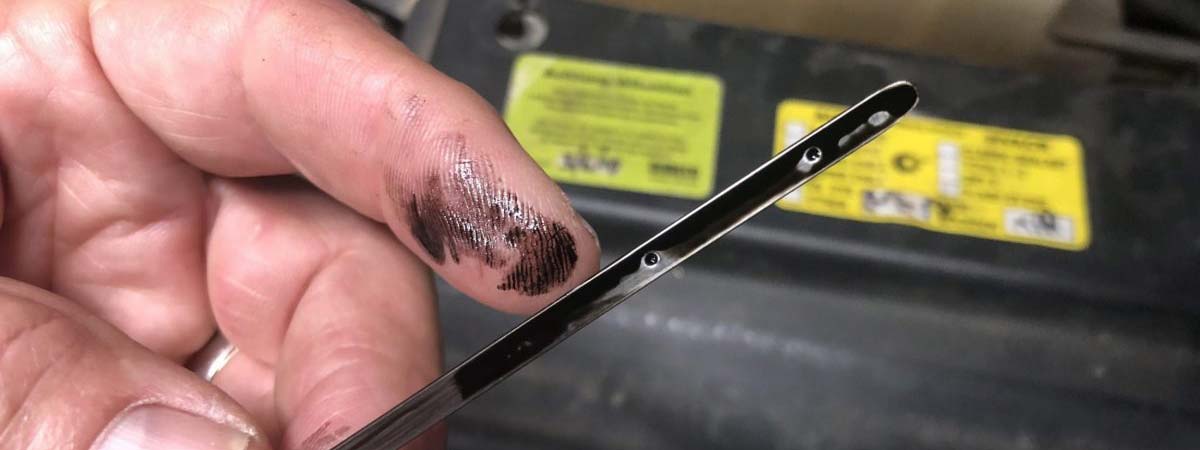
Why flush a diesel engine?
It’s often been said: “If your engine’s oil is changed according to schedule, it should never need a flush!”
In a perfect world that might be so, but there are numerous factors that cause engine sludge to build up and piston rings to become fouled. With emission control components fitted to today’s engines, along with extended oil-change intervals and city driving cycles, black oil sludge is now more common than ever.
Short answer: flush a diesel engine when the oil goes black quickly, by around 100,000km, or whenever a service is missed. A flush with Flushing Oil Concentrate removes the sludge and carbon that normal oil changes leave behind — and it’s as easy as an oil change.
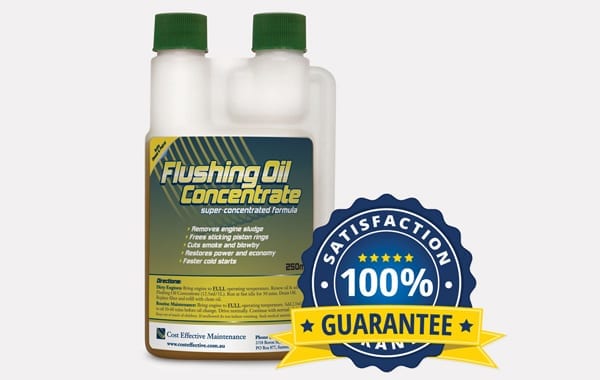
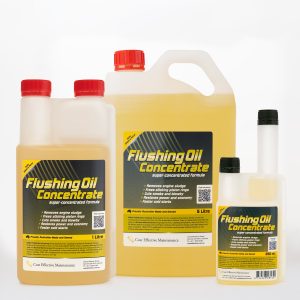
Flushing Oil Concentrate safely removes all built-up engine sludge and old oil from your engine.
As simple as completing an oil change.
Why Do I Need to Flush My Engine?
City driving is notorious for producing carbon deposits in combustion and exhaust spaces — importantly, in the piston ring grooves. This leads to exhaust gas recirculation (EGR) valves fouling up, which puts more soot into the oil. DPF regeneration cycles can also dilute your oil with diesel and soot.
Fuel injectors have finer tolerances that become easily fouled, contributing to poor combustion and further deposits entering the oil. Australia’s higher ambient temperatures and greater travel distances don’t always fit well with the northern-hemisphere-based extended oil intervals.
Many of today’s modern diesel engines travel twice as far as older diesels before the recommended log-book service is due. A 20,000km oil-change interval is a long time between oil changes! Even after a dealer’s log-book service, the oil can be black on the dipstick before you’ve left the car park.
Once your vehicle has done 100,000km, it will almost certainly be time to flush the diesel engine. And by missing an oil change, or failing to change the oil filter between services, the engine may need a flush as early as 30,000–40,000km.
The aim should be to keep your engine clean from new. That means the oil should always “look and feel clean” straight after a service, and shouldn’t discolour straight away. A successful flush at each service ensures all the old, black, built-up oil is removed.
When it’s time to flush a diesel engine with CEM’s Flushing Oil Concentrate, in almost all cases it results in an increase in compression — from dissolving, dispersing and removing the carbon around the piston ring grooves. This clearly demonstrates the value of a quality engine flush.
It’s quite an easy DIY process to flush a diesel engine — as simple as completing an oil change. By following this easy 6-step process, you’ll safely remove unwanted sludge and built-up carbon, leaving the crankcase “as new” clean. For a related real-world example, see our guide on using Flushing Oil Concentrate in a new vehicle.
6 Easy Steps to Flush a Diesel Engine
Step 1 — Drain the old oil while hot
Drain the old oil out hot, so you remove as much contaminant as possible first — this gives the best possible clean-up result.
Step 2 — Add fresh oil and the Flush
Add fresh oil (a cheap oil is fine for this part) and run the engine to warm the oil, then add Flushing Oil Concentrate at 125mL per 10L of oil capacity. For example, a Landcruiser or Patrol 4.2L diesel needs 125mL for a 10L sump; a Series 60 Detroit needs 500mL for a 40L sump.
Step 3 — Run at a fast idle for 30 minutes
Run the engine at a fast idle, parked up, for 30 minutes. For most 4x4s, that’s 1,500–2,000rpm. For larger truck engines (e.g. Series 60 Detroit, Cat, Mack, Cummins), run at about 1,200rpm.
Step 4 — Drop the oil again
Drain the oil a second time, and watch all the built-up muck flow out with the flush.
Step 5 — Refill with good oil and a new filter
Add a good-quality engine oil and a new filter — it will now easily last the full recommended service interval. This is also the perfect time to add AW10 Antiwear for added protection and quieter, freer-revving running.
Step 6 — Final check
Make sure there are no leaks, take it for a quick run, and recheck the oil level. To keep it clean from here on, just add a small amount of Flush to the old oil 30 minutes before each oil change — for a Hilux, that’s a mere 15mL per change.
For more information on flushing diesel engines, give Brid and the team at Cost Effective Maintenance a call on +61 7 3376 6188.
Recommended Products to Flush a Diesel Engine
-
 Value Packs
Flushing Oil Concentrate & Cleanpower Value Pack
From Original price was: $170.00.$130.00Current price is: $130.00. incl. GSTSelect options This product has multiple variants. The options may be chosen on the product page -
 Value Packs
Flushing Oil Concentrate & CRD Fuel Enhancer Value Pack
From Original price was: $174.00.$135.00Current price is: $135.00. incl. GSTSelect options This product has multiple variants. The options may be chosen on the product page -
 Engine Blowby, Engine Overheating, Main-products, Oil Additives, Oil Sludge Remover, Our Products
Flushing Oil Concentrate for Diesel and Petrol Engines
From $115.00 incl. GSTSelect options This product has multiple variants. The options may be chosen on the product page